Description
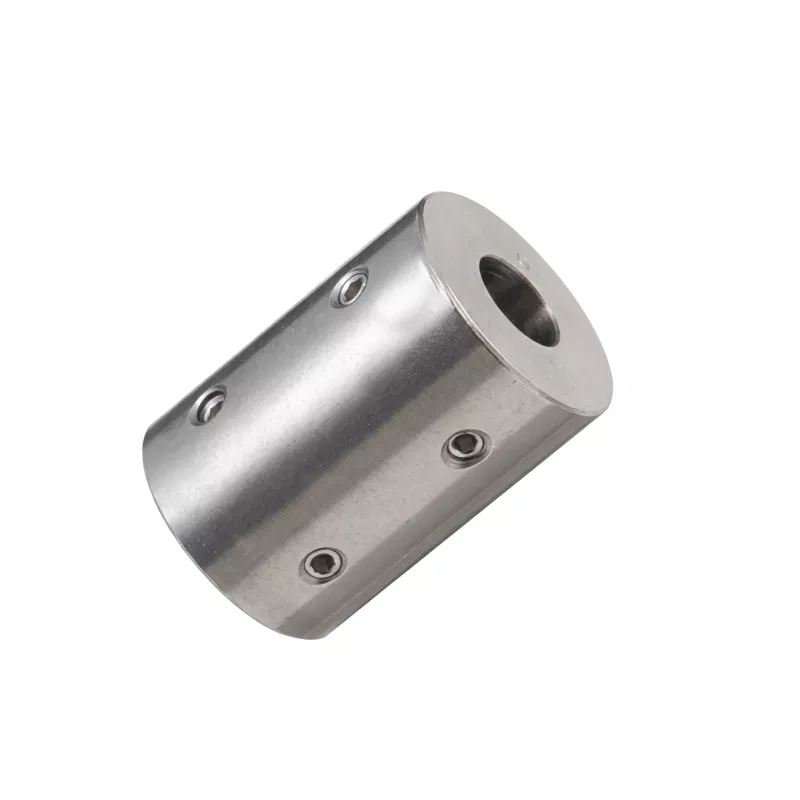
GT1 GT Type Sleeve Coupling – 12–16mm Bore Rigid Muff Coupling for Zero-Backlash Shaft Connection
The GT1 GT type sleeve coupling — also known as a muff coupling — is the simplest and most direct form of rigid shaft coupling: a single cylindrical steel body with a through bore machined to receive two co-linear shaft ends, transmitting torque through keyway and fitted key engagement on each shaft side. At 42 mm outer diameter and 82 mm overall length, the GT1 provides a compact, maintenance-free rigid connection for 12–16 mm shaft diameters, rated at 25 N·m nominal torque at up to 12500 rpm maximum speed. At the smallest end of the GT sleeve series, the GT1 targets high-speed miniature drive connections up to 12500 rpm — the highest speed rating in the GT range. With a 12–16 mm bore and 42 mm OD, it provides the simplest possible rigid connection between co-linear shafts in compact automation equipment.
The operating principle of the GT sleeve coupling is direct and reliable. Each shaft end is inserted into one half of the sleeve bore. A fitted key is placed in the matching keyways of both the shaft and the sleeve bore on each side — two keys total, typically positioned 180° apart. When the coupling rotates, torque is transmitted from the driving shaft to the sleeve through key-keyway bearing contact, and from the sleeve to the driven shaft through the same mechanism on the opposite side. There are no flexible elements, no preloaded fasteners to maintain, and no wear surfaces subject to degradation under normal operating conditions. The result is a permanent, zero-backlash connection that requires essentially no maintenance throughout its service life, provided the connected shafts remain accurately aligned.
The H7 bore tolerance and GB3852-1997 keyway standard ensure dimensional compatibility with standard motor and driven equipment shaft ends throughout the GT series. For special shaft configurations — non-standard diameters, tapered bores, or hydraulic fit bores — custom machining is available. The complete GT series, from GT1 through GT10, is listed on our product catalog page.
Technical Specifications
| Parameter | Value |
|---|---|
| Model | GT1 |
| Type | GT Type Sleeve Coupling (Muff Coupling) |
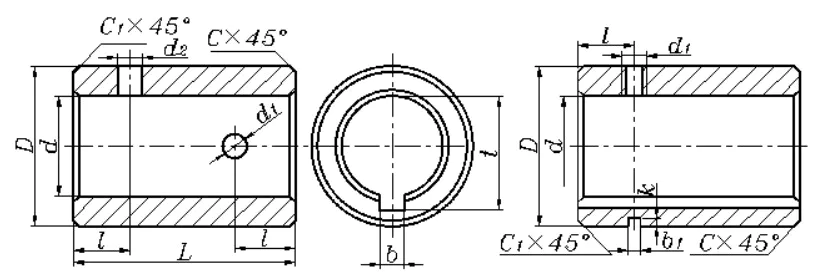
| Bore Range (d) | 12–16 mm |
| Outer Diameter (D) | 42 mm |
| Overall Length (L) | 82 mm |
| Nominal Torque (Tn) | 25 N·m |
| Maximum Speed [n] | 12500 rpm |
| Bore Tolerance | H7 standard |
| Keyway Standard | GB3852-1997 |
| Mass | 0.5 kg |
Dimension Reference
Construction and Functional Features
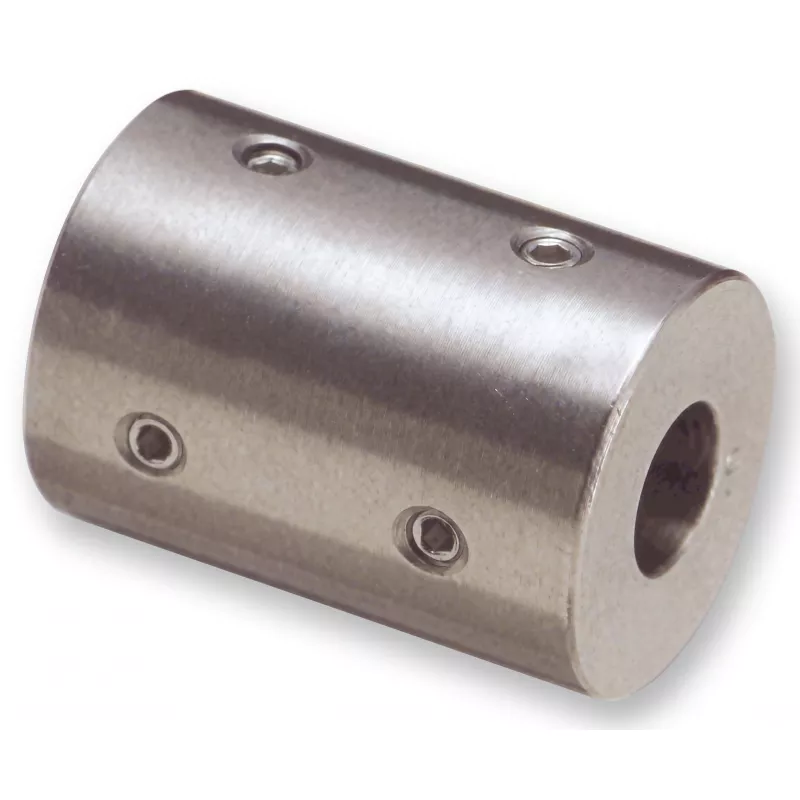
The GT1 body is machined from high-quality cast iron or cast steel — material selection dependent on model size and rated torque. The bore is machined to H7 tolerance to provide a controlled fit against the shaft end, complementing the key-keyway torque transmission with a stable radial contact between shaft and bore. The outer diameter is machined concentric with the bore to ensure rotational balance. Keyway slots are machined to GB3852-1997 standard dimensions for the specified bore size — verifying compatibility with standard motor shaft keyways without modification.
Zero Backlash
Rigid key-keyway torque transmission with no play or compliance — every angular increment on the driving shaft is replicated exactly on the driven shaft. Essential for phase-critical and encoder feedback applications.
Maintenance-Free Service Life
No wear elements, no elastomeric components to degrade, no bolts to retorque. Once correctly installed on aligned shafts, the GT sleeve coupling requires no maintenance throughout its service life.
Compact One-Piece Design
Single cylindrical body — no bolted flanges, no split halves, no external fasteners. Lowest-profile rigid coupling available for co-linear shaft connections, minimising guard size and axial space requirements.
Standard Keyway Compatibility
Bore and keyway dimensions to GB3852-1997 and H7 bore tolerance ensure direct compatibility with standard motor and driven equipment shaft ends throughout the industrial motor range.
Manufacturing Quality
Typical Applications
- Precision instrument and automation drives — where zero backlash and angular fidelity between shafts are required
- High-speed motor to driven shaft connections — up to the model’s maximum speed rating with minimal added inertia
- Printing and packaging machine drives — phase-critical connections where indexing accuracy is essential
- Pump direct drive connections — close-coupled motor-to-pump rigid shaft coupling
For technical enquiries and volume supply information, visit our contact page.
Customer Reviews and Case Studies
★★★★★
Germany — Textile Machinery OEM
We connect feed roller shafts using GT1 sleeve couplings throughout our weaving machine product line. The solid one-piece steel body transmits our 25 N·m drive torque reliably and the 12,500 rpm rating gives ample headroom above our operating speed. After 18 months of continuous production, no maintenance has been required on any installed unit.
— Design Engineer, Stuttgart
★★★★★
Japan — Laboratory Instrument Manufacturing
Specified GT1 for precision analytical drive shaft connections. The rigid sleeve coupling ensures zero angular error between motor and driven shaft — critical for measurement repeatability. Dimensional accuracy was verified on arrival.
— Instrument Engineer, Tokyo
★★★★☆
Australia — Packaging Machinery
Used on small-format packaging line feed connections. The GT1’s compact 42 mm OD fits within our machine’s tight envelope and the rigid connection maintains accurate phase relationship between the motor and the packaging index wheel.
— Mechanical Engineer, Melbourne
Frequently Asked Questions
What is a sleeve coupling (muff coupling) and how does it work?
A sleeve coupling — also called a muff coupling — is the simplest form of rigid shaft coupling. It consists of a single cylindrical steel body with a through bore machined to receive both shaft ends from opposite sides. Torque is transmitted from the driving shaft through the sleeve bore via keyways and fitted keys, then out to the driven shaft through the same mechanism. The sleeve provides a rigid, zero-backlash connection with no flexible elements.
What shaft end preparation is required for GT sleeve coupling installation?
Each shaft end requires a machined keyway to the GB3852 standard dimensions for the bore diameter. The keyway must be cut to the standard width and depth for the key size specified for that bore. Both shaft ends and the corresponding bore sections of the sleeve must be machined to H7/k6 or H7/n6 tolerance fit as specified for the drive torque level.
Can the GT sleeve coupling be installed where shaft end access is restricted?
The GT sleeve coupling requires axial shaft movement for installation — the sleeve must be slid axially onto one shaft end, the two shafts brought into axial alignment, and the sleeve then slid to centre over the joint. This requires axial freedom on at least one shaft. Where axial movement is not possible, a split-body clamp coupling design may be more appropriate.
What keyway standard applies to the GT sleeve coupling bore?
Keyway and shaft hole diameter dimensions conform to GB3852-1997 《Keyway and shaft hole dimensions》. The key form (A-type parallel key) and dimensions are selected based on the shaft bore diameter according to this standard. When ordering, specify the keyway dimensions if non-standard sizes are required.
What is the difference between the GT sleeve coupling and a flanged coupling?
A GT sleeve coupling is a one-piece cylindrical body that slides over both shaft ends — simple, compact, and lowest-cost for co-linear shaft connections. A flanged coupling consists of two hub halves bolted together at a central flange — allowing disassembly without axial shaft movement and providing a defined torque break plane. Flanged couplings are preferred where regular disassembly is required; sleeve couplings where permanent or infrequent connection is acceptable.
Source the GT1 GT Sleeve Coupling
Ever Power manufactures the GT1 and the complete GT sleeve coupling series — GT1 through GT10, covering 12 mm to 200 mm bore — direct from our factory. Specify bore diameters, keyway requirements, and any non-standard dimensions for a prompt technical and commercial response.