Description
TS7C-20 Clamp Type Rigid Coupling – Aluminum Alloy 20mm OD Split-Body Precision Shaft Connector
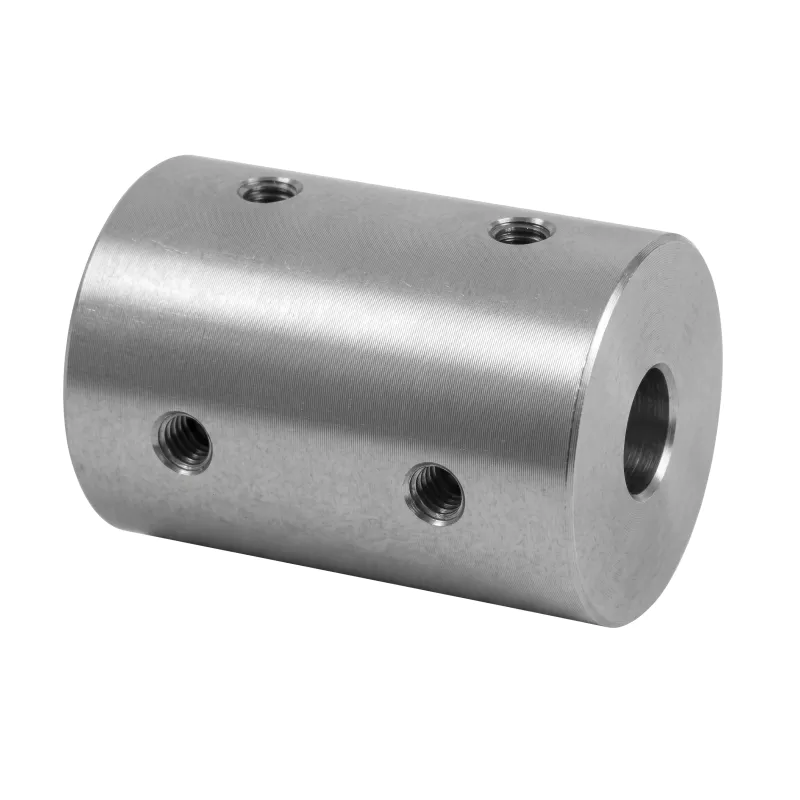
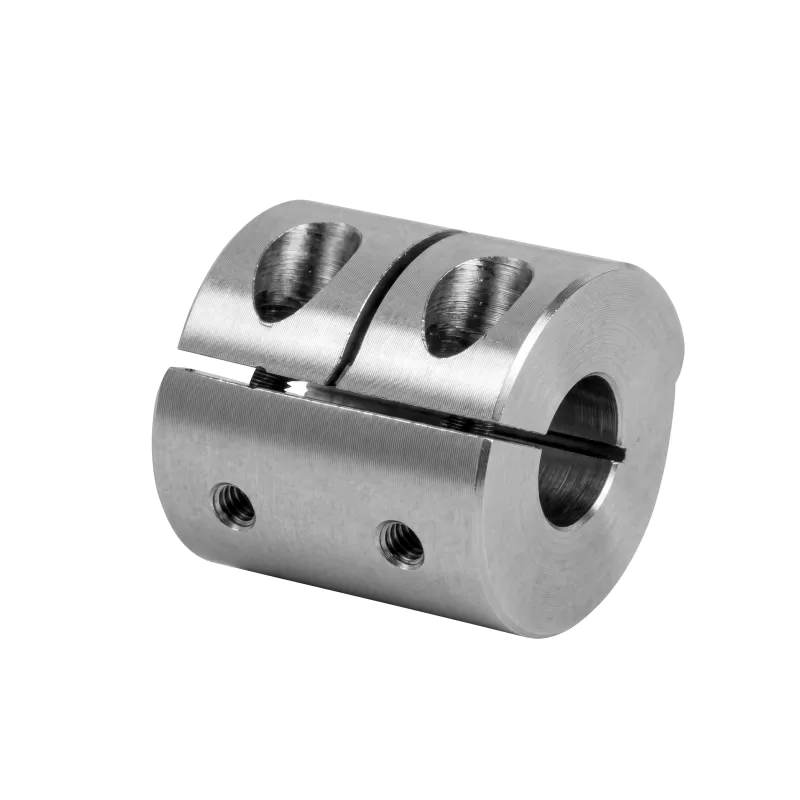
The TS7C-20 clamp type rigid coupling is the 20 mm outer diameter model in the TS7C aluminum alloy clamp series, rated at 0.5 N·m nominal torque and 5,400 rpm maximum rotational speed. It accepts bore diameters of 6 and 8 mm — covering the most common stepper motor and BLDC motor shaft sizes in this torque bracket — and uses M3 clamp screws to compress the split body uniformly around each shaft end. At 14.5 g, it is a compact and lightweight coupling suited to benchtop automation, precision positioning stages, and encoder drive connections where the non-marring clamp mechanism is preferred over a setscrew connection.
The split-body clamp architecture of the TS7C series represents a meaningful engineering choice compared to the TS7 setscrew series. The setscrew applies clamping force at a single contact point and is optimal where maximum rotational speed and simplest installation are the primary criteria. The clamp mechanism distributes force uniformly and is optimal where shaft surface protection, repositionability during commissioning, or use on hardened or precision-ground shafts makes point-contact setscrew gripping unsuitable or undesirable. Both series deliver zero-backlash rigid torque transmission — the torque ratings and bore ranges within each frame size are matched between TS7 and TS7C.
The M3 clamp screws at this frame size represent an upgrade from the M2 screws used in the TS7C-16, providing more available clamping force for the higher rated torque of the 20 mm frame. The stainless steel equivalent, the STS7C-20, is listed alongside all TS7C models in our full catalog.
Technical Specifications
| Parameter | Value |
|---|---|
| Model | TS7C-20 |
| Series | TS7C Clamp Type Rigid Coupling |
| Body Material | Aluminum Alloy |
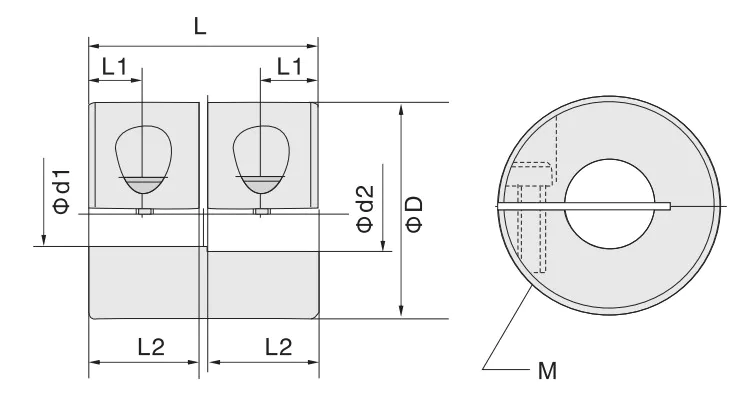
| Outer Diameter (D) | 20 mm |
| Overall Length (L) | 30 mm |
| Hub Length (L1) | 9 mm |
| Available Bore Sizes | 6, 8 mm |
| Clamp Screw Thread | M3 |
| Rated Torque | 0.5 N·m |
| Maximum Torque | 1 N·m |
| Maximum Rotational Speed | 5,400 rpm |
| Moment of Inertia | 8.8 × 10⁻⁷ kg·m² |
| Mass | 14.5 g |
Dimension Drawing
Clamp Mechanism Detail
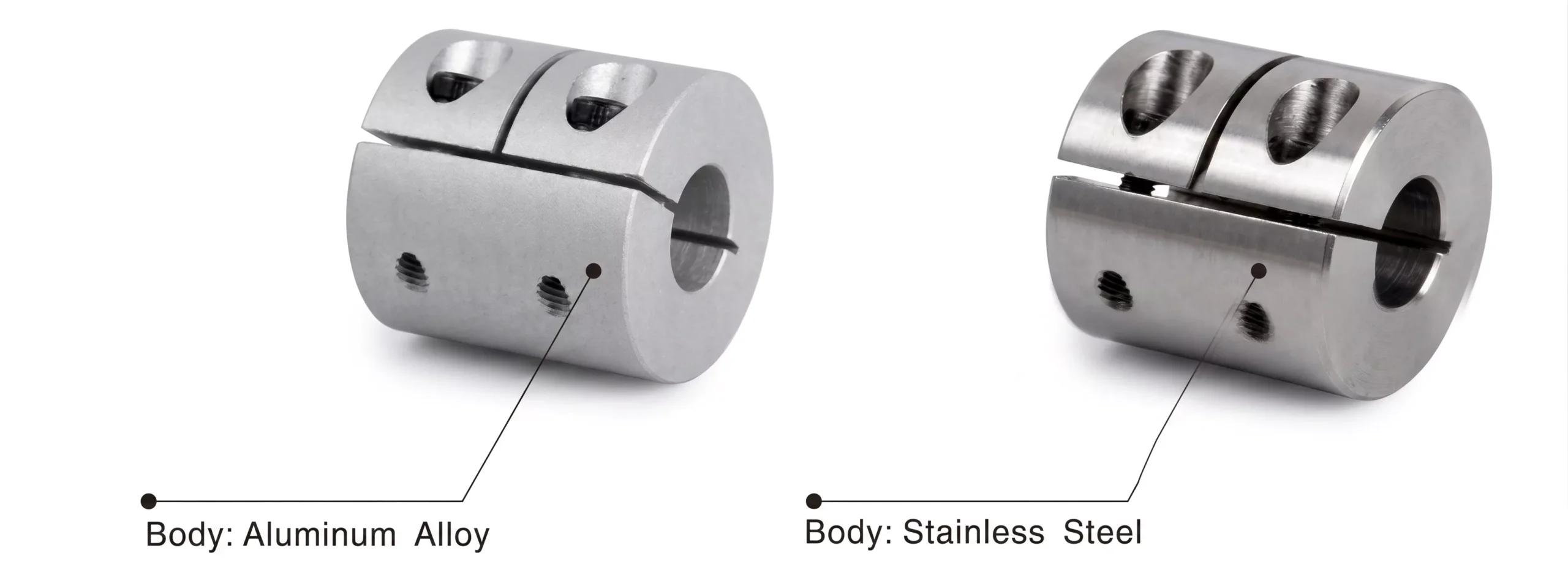
The clamp mechanism on the TS7C-20 consists of a precision longitudinal slot cut through the coupling body on each hub side, with an M3 socket head cap screw spanning the slot to draw the two faces together. When tightened, the slot closes and the bore contracts uniformly around the shaft, creating a distributed clamping contact around the full 360° of shaft circumference. The installation procedure requires inserting each shaft to the correct axial depth — indicated by the hub length L1 of 9 mm — and tightening the clamp screws alternately in small increments to achieve even compression. This controlled tightening sequence is more involved than a single setscrew operation but results in a more mechanically consistent grip across the full bore contact area.
Typical Applications
- Stepper motor to leadscrew connections in 3D printing and CNC routing where axial coupling position may need adjustment during commissioning
- BLDC motor shaft couplings in compact actuator designs where shaft surface marking from setscrews must be avoided
- Precision gantry and linear stage drives — Y and Z axis connections requiring non-marring coupling to protect precision ground shaft surfaces
- Rotary encoder connections to driven shafts where the encoder’s shaft surface warranty requires a clamp-type connection
- Compact robotic finger and gripper drive shafts — where torque reversal and repositionability during assembly are operational requirements
Customer Reviews and Case Studies
★★★★★
South Korea — Precision Automation OEM
We use the TS7C-20 in our precision linear gantry drives where the coupling must be removed and repositioned during axis calibration. The clamp mechanism allows this without marking our precision ground shaft surfaces. Zero-backlash performance has been consistent across 300+ units over two production cycles.
— Mechanical Engineer, Incheon
★★★★★
Sweden — Robotics Research Institute
Specified for finger joint drives on a dexterous manipulation robot. The 6/8 mm mixed bore connected our servo motor output to the finger shaft directly. The clamp allowed us to adjust the coupling’s axial position repeatedly during kinematic calibration without any shaft surface degradation.
— Research Engineer, Stockholm
★★★★☆
Italy — CNC Machine Tool Builder
Used on Z-axis encoder connections where our hardened ball screw shaft cannot accept setscrew contact. The TS7C-20 clamp is the correct solution — it grips without indentation. Dimensional accuracy was confirmed on arrival inspection and all units were within our 0.01 mm bore tolerance requirement.
— Design Engineer, Milan
Frequently Asked Questions
What bore sizes are available for the TS7C-20?
The TS7C-20 accepts bore diameters of 6 and 8 mm on each side. Both same-bore (6/6 or 8/8) and mixed-bore (6/8) configurations are available at standard pricing.
How does the TS7C-20 compare to the TS7-20 in terms of shaft grip?
The TS7C-20 clamp mechanism distributes clamping force around the full shaft circumference, providing more uniform shaft engagement than the point-contact setscrew of the TS7-20. This reduces the risk of shaft surface marking and allows removal without shaft damage, at the cost of a lower maximum speed (5,400 rpm vs 18,000 rpm).
What is the clamp screw tightening procedure for the TS7C-20?
Tighten the M3 clamp screws alternately and progressively to ensure even compression of the split body. Use a calibrated torque driver and refer to the tightening torque specified in the installation sheet for the M3 screw size at this frame.
Can the TS7C-20 be used on hardened shafts?
Yes. The clamp mechanism is particularly well suited to hardened shafts because it does not require point-contact indentation for grip — a setscrew on a hardened shaft can cause surface cracking. The clamp distributes load over the full bore contact area.
Is the TS7C-20 suitable for high-cycle reversing applications?
The clamp mechanism maintains its grip without loosening under moderate reversing torque loads within the rated capacity. For high-cycle, high-reversal applications near rated torque, periodic retightening of the clamp screws is recommended as part of planned maintenance.
Enquire About the TS7C-20 Clamp Rigid Coupling
Ever Power supplies the TS7C-20 and the complete TS7C clamp series from our factory. Tell us your bore sizes, application, and quantity — we will confirm technical suitability and factory pricing.