Description
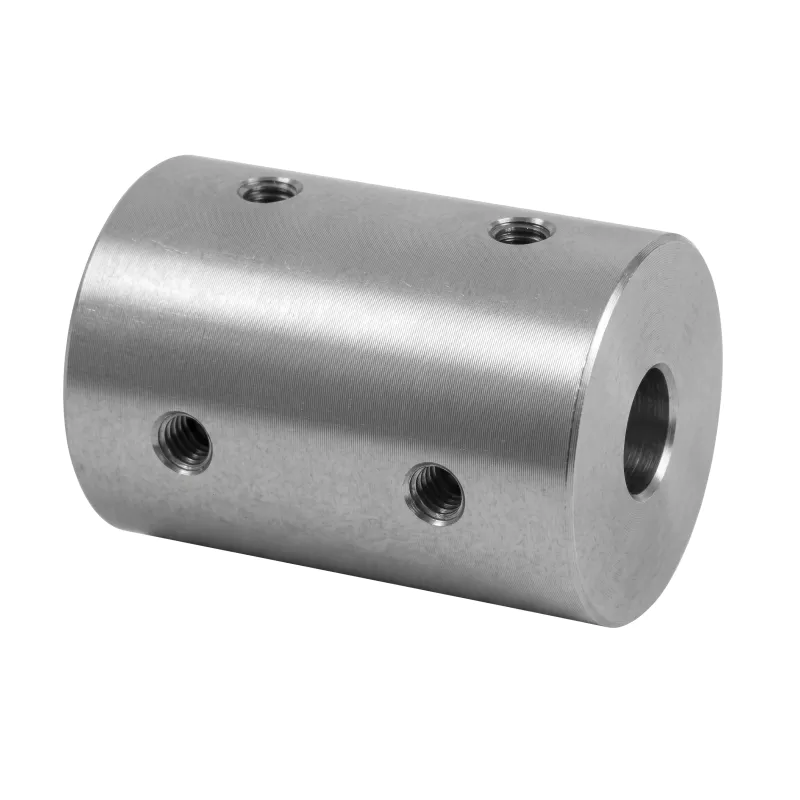
TS7C-16 Clamp Type Rigid Coupling – Aluminum Alloy 16mm OD Split-Body Precision Shaft Connector
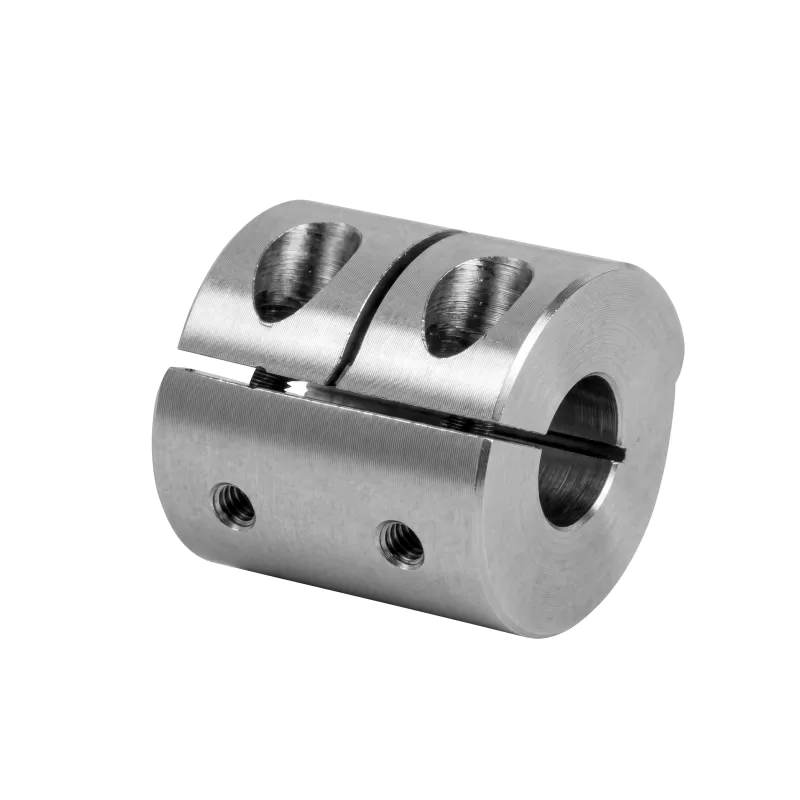
The TS7C-16 clamp type rigid coupling introduces a fundamentally different shaft retention mechanism compared to the TS7 setscrew series. Where the TS7 setscrew models use a single grub screw to apply point-contact clamping force against the shaft surface, the TS7C-16 employs a split-body clamp design: the coupling body is divided lengthwise by a precision slot, and M2 clamp screws draw the two halves of the bore together to compress uniformly around the shaft circumference. This distributed clamping force eliminates the shaft surface marking that is inherent to setscrew connections, allows the coupling to be repositioned axially without shaft damage, and provides a more repeatable installation torque-to-grip-force relationship across repeated removal and re-installation cycles.
The TS7C-16 body is machined from aluminum alloy to a 16 mm outer diameter and 25 mm overall length, with a bore range of 5 and 6 mm covering the miniature instrumentation shaft sizes in this coupling’s torque class. At 8.2 g, it is the lightest body in the TS7C clamp series — notably lighter than the solid-body TS7-16 setscrew at 11 g despite carrying the same OD, because the material removed by the body slot more than offsets the clamp screw additions. Rated torque is 0.3 N·m nominal and 0.6 N·m maximum, identical to the TS7-16, at a maximum speed of 7,300 rpm — lower than the setscrew equivalent due to the inherent mass asymmetry of the split body but still appropriate for the encoder connections, stepper motor drives, and precision positioning axes that constitute the primary market for this frame size.
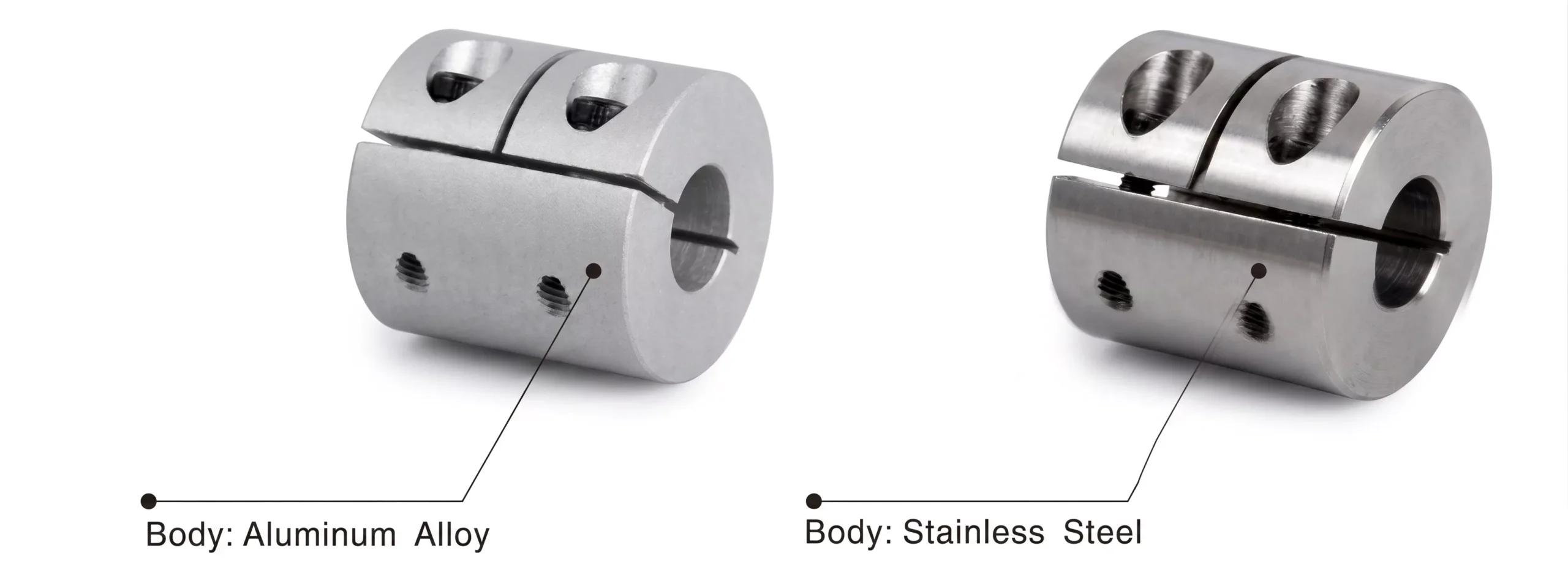
For corrosion-resistant installations, the STS7C-16 in 316 stainless steel provides equivalent performance. Both the TS7C and STS7C clamp coupling ranges are listed on our product catalog page.
Technical Specifications
| Parameter | Value |
|---|---|
| Model | TS7C-16 |
| Series | TS7C Clamp Type Rigid Coupling |
| Body Material | Aluminum Alloy |
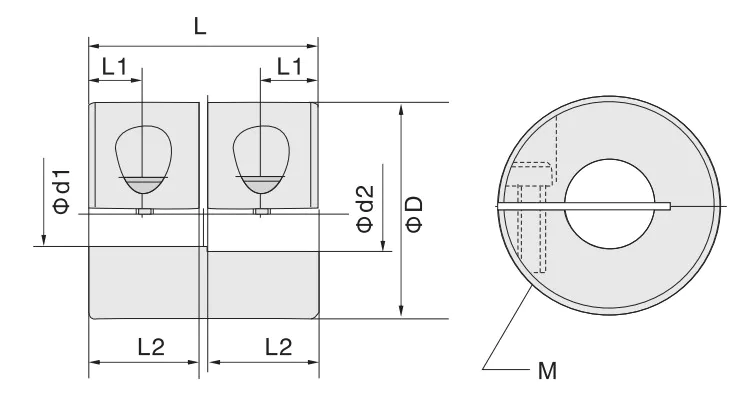
| Outer Diameter (D) | 16 mm |
| Overall Length (L) | 25 mm |
| Hub Length (L1) | 7.5 mm |
| Available Bore Sizes | 5, 6 mm |
| Clamp Screw Thread | M2 |
| Rated Torque | 0.3 N·m |
| Maximum Torque | 0.6 N·m |
| Maximum Rotational Speed | 7,300 rpm |
| Moment of Inertia | 3.2 × 10⁻⁷ kg·m² |
| Mass | 8.2 g |
Dimension Drawing
Split-Body Clamp Design — Key Advantages
Non-Marring Shaft Connection
The clamp mechanism distributes gripping force uniformly around the shaft circumference, leaving no indentation or surface marking. This is critical for encoder shafts, where surface condition affects manufacturer warranty and bearing alignment, and for hardened shafts where setscrew contact would cause surface cracking.
Repositionable Without Shaft Damage
The TS7C-16 can be loosened and moved axially along the shaft without leaving marks that would compromise the shaft surface for future installations. This flexibility is valuable in precision instrument design where fine axial adjustment of component position may be required during commissioning.
Zero Backlash Rigid Connection
Despite the split body, the TS7C-16 delivers full rigid zero-backlash torque transmission. The clamp screws draw the body halves together with sufficient force to eliminate any play between the coupling body and shaft — angular position fidelity is maintained to the same standard as a solid-body rigid coupling.
Ultra-Low Mass
At 8.2 g — less than the 11 g TS7-16 setscrew version — the TS7C-16 contributes negligible rotational inertia to the drive system. This is the lightest coupling in the TS7C range and particularly suited to the miniature drive trains in laboratory instruments and precision motion stages.
Typical Applications
- Rotary encoder shaft connections — particularly where encoder shaft surface condition must be preserved, as a non-marring clamp connection is required by many encoder manufacturers
- Precision scanning instrument drives — confocal microscope stage drives, scanning probe systems, optical coherence tomography positioning axes
- Miniature servo and stepper motor output shaft connections where shaft repositioning flexibility during system commissioning is valued
- Dental and surgical instrument positioning drives — where frequent sterilisation cycles require the coupling to be removed and replaced without shaft damage
- Research and educational laboratory equipment — student laboratory instruments requiring non-destructive disassembly
For the full range of clamp type rigid coupling applications across industry sectors, visit our product catalog.
Customer Reviews and Case Studies
★★★★★
Germany — Optical Instrument OEM
We mount rotary encoders on precision scanning stages using the TS7C-16. The encoder manufacturer specifically requires a non-marring shaft connection — a setscrew would void the encoder warranty. The TS7C-16 clamp meets this requirement exactly, and the zero-backlash performance has been consistent across all our production units over 18 months.
— Design Engineer, Jena
★★★★★
United States — Medical Device Engineering
Used in a surgical instrument positioning drive where the coupling is removed during sterilisation cycles. The clamp mechanism allows removal and re-installation over 200 sterilisation cycles without any shaft surface damage or degradation in torque holding. The 5/6 mm bore covers our motor and encoder shaft combination.
— R&D Engineer, Minneapolis
★★★★☆
Japan — Research Laboratory Equipment
Installed in a confocal microscope Z-axis drive. The coupling needed to be repositioned multiple times during optical alignment commissioning. The TS7C-16 allowed this without marking the motor shaft, which would have complicated later system reconfiguration. Dimensional accuracy was excellent.
— Instrument Engineer, Osaka
Frequently Asked Questions
How does the TS7C clamp mechanism differ from the TS7 setscrew?
The TS7C uses a split-body clamp design: the coupling body is split lengthwise along one side and tightened with clamp screws that compress the bore around the shaft uniformly. This distributes clamping force around the full shaft circumference, in contrast to the setscrew which applies force at a single contact point. The clamp design eliminates shaft surface marking and allows the coupling to be repositioned without shaft damage.
Can the TS7C-16 be installed and removed without damaging the shaft?
Yes. Because the clamp mechanism grips the shaft uniformly rather than through a point-contact setscrew, the TS7C-16 can be loosened and repositioned without leaving indentations on the shaft surface. This makes it suitable for applications requiring frequent adjustment of shaft position or axial location of the coupling.
What bore sizes are available for the TS7C-16?
The TS7C-16 accepts bore diameters of 5 and 6 mm. Both d1 and d2 can be any combination of these two sizes. Mixed bore (5 mm and 6 mm) configurations are available at standard pricing.
Why is the maximum speed lower for the TS7C-16 than the TS7-16?
The split-body clamp design introduces a small mass asymmetry that limits the balanced rotational speed compared to the solid-body TS7-16 (setscrew). The TS7C-16 is rated to 7,300 rpm — sufficient for most stepper and servo motor direct-drive applications in its torque class, but lower than the 23,000 rpm of the solid-body TS7-16.
Is the TS7C-16 suitable for encoder shaft connections?
Yes. The clamp mechanism provides zero backlash rigid connection ideally suited for encoder shaft mounting. The non-marring shaft grip is especially advantageous on encoder shafts where surface condition affects the encoder manufacturer’s warranty and the encoder’s internal bearing alignment.
Source the TS7C-16 Clamp Rigid Coupling
Ever Power manufactures the TS7C-16 and the complete TS7C clamp rigid coupling series direct from our factory. Provide your bore sizes, quantity, and application details for a prompt technical and commercial response.