Description
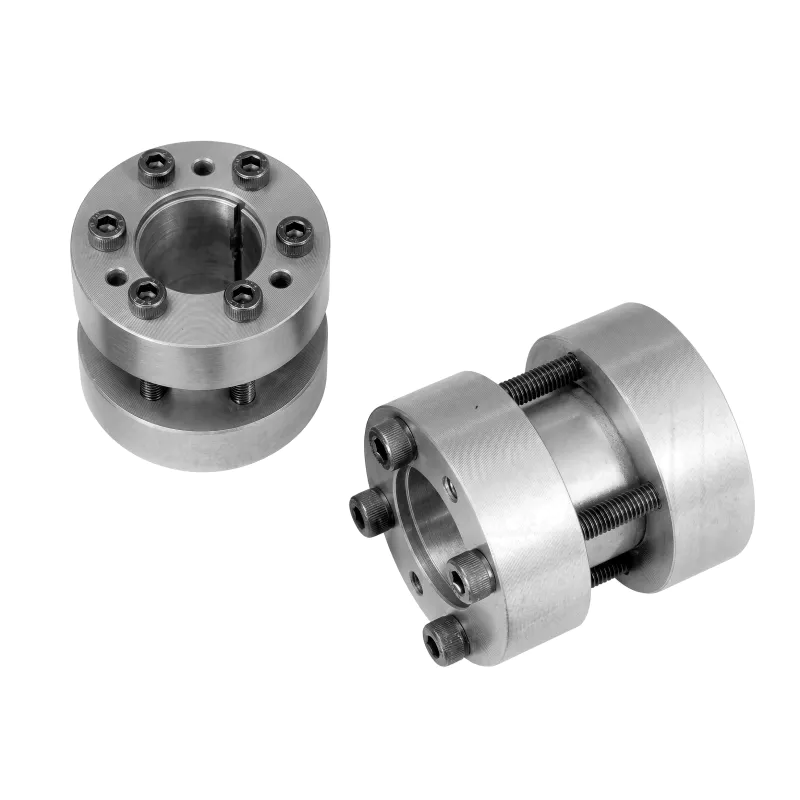
TS7Z16×45 Locking Assembly – 16mm Shaft 45mm OD Keyless Rigid Shaft-Hub Connector
The TS7Z16×45 addresses the 16 mm shaft size common in compact industrial motors, agitator drives, and light gearbox applications. The 45 mm outer diameter fits within the confined hub geometries typical of compact drives in this shaft class, and the 119 MPa surface pressure — the highest in the TS7Z series — is easily supported by standard carbon steel shaft materials. For a complete listing of all TS7Z locking assembly models, visit our product catalog.
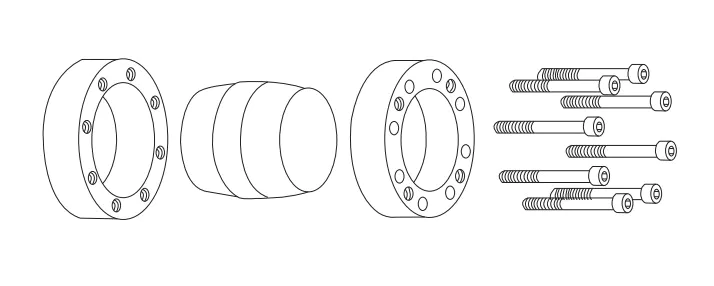
The TS7Z locking assembly operates on the principle of tapered ring compression: two tapered steel rings — inner and outer — are drawn together axially by the clamping screws. The taper geometry converts axial screw preload into a radial clamping force, expanding the inner ring against the shaft surface and contracting the outer ring against the hub bore simultaneously. The resulting surface pressure — 119 MPa for the TS7Z16×45 at the specified M_a of 17 N·m — generates a friction connection that transmits both torque (Mt = 0.134 kN·m) and axial force (Ft = 16.8 kN) without any mechanical interlock element. No keyway is required in either the shaft or the hub bore.
The elimination of the keyway is the principal engineering advantage of the TS7Z over traditional keyed hub connections. A keyway introduces a stress concentration at its corners that can initiate fatigue cracks under the cyclic torsion loading of a rotating drive — particularly at high surface hardness or in applications with frequent torque reversals. The TS7Z distributes torque loading uniformly around the full circumference of the shaft bore, eliminating this stress riser and significantly extending the fatigue life of the connected shafts. For high-cycle, high-torque drives — mills, fans, compressors, and crushers — this durability improvement is a primary selection rationale.
Technical Specifications
| Parameter | Value |
|---|---|
| Model | TS7Z16×45 |
| Type | Locking Assembly (Keyless Shaft-Hub Connection) |
| Shaft Bore (d) | 16 mm |
| Outer Diameter (D) | 45 mm |
| Rated Axial Force (Ft) | 16.8 kN |
| Rated Torque (Mt) | 0.134 kN·m |
| Surface Pressure (Ps) | 119 MPa |
| Installation Screw Torque (Ma) | 17 N·m |
| Mass (G) | 0.4 kg |
| Material | Steel |
| Standard | GB/T 5106 compatible |
Dimensional Reference
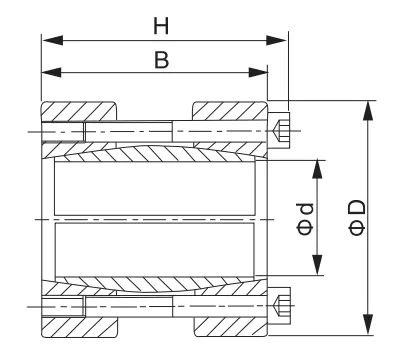
Structural Cross-Section
Installation and Design Guidance
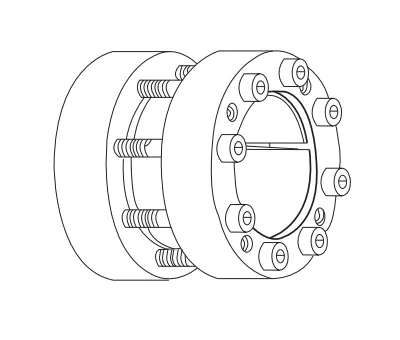
Installation of the TS7Z16×45 requires the shaft surface to be clean, dry, and within an h6 or k6 shaft tolerance, with a surface finish of Ra 0.8–1.6 μm. The hub bore should be machined to H7 tolerance. Clamping screw threads and head bearing faces must be lubricated with MoS₂ paste before installation to ensure the M_a = 17 N·m tightening torque produces the correct clamping force. Tighten all screws in a star pattern in at least three progressive passes — do not fully tighten one screw before the others.
To verify shaft material suitability, check: Ps (119 MPa) ≤ 0.9 × shaft yield strength. For C45 steel (yield ~370 MPa): 0.9 × 370 = 333 MPa > 119 MPa — acceptable. For aluminium alloy 6061-T6 (yield ~275 MPa): 0.9 × 275 = 247 MPa; compare with 119 MPa for this model. If the shaft material yield strength is insufficient, contact our contact our team for a re-rated configuration.
Keyless Design
No keyway in shaft or hub. Eliminates keyway stress concentration and fretting wear. Angular position can be set freely — no keyway angular constraint.
Self-Releasing Disassembly
Back off clamping screws in a star pattern — the taper geometry produces a self-releasing action requiring no extraction tools or heat. Shaft and hub surfaces are undamaged after removal.
Uniform Load Distribution
Torque is transmitted through friction uniformly around the full shaft circumference, distributing stress evenly and enabling the same torque to be carried at lower peak shaft stress than a keyed connection.
Bidirectional Torque
Frictional connection transmits equal torque in both rotational directions. No directional constraint — suitable for reversing drive applications without additional design consideration.
Customer Reviews and Case Studies
★★★★★
United Kingdom — Paper Mill Equipment
We use the TS7Z16×45 in our paper machine dryer section drive connections. The locking assembly provided a repeatable, calibrated installation that eliminated the variability we saw with previous keyway connections. The 0.134 kN·m torque capacity provides a comfortable safety margin over our peak drive torque.
— Technical Buyer, Birmingham
★★★★★
Brazil — Steel Rolling Mill
Fitted the TS7Z16×45 on hot strip mill coiler mandrel drive connections. Temperature in this area reaches 60°C; the locking assembly’s static friction connection is unaffected by thermal cycling where a keyed connection would develop fretting wear over time. The 119 MPa contact pressure distributes the load evenly around the shaft circumference.
— Engineering Manager, São Paulo
★★★★☆
South Korea — Chemical Process Plant
Used in agitator drive shaft connections on our chemical reactor vessels. The TS7Z16×45 allows shaft removal for vessel maintenance without shaft modification — the locking assembly releases cleanly when the screws are backed off, unlike interference-fit hubs that require heating and pressing. The 16.8 kN axial load capacity covers our process torque requirements with margin.
— Senior Designer, Busan
Frequently Asked Questions
Can a locking assembly be reused after disassembly?
Yes. TS7Z locking assemblies can be disassembled and reused, provided the shaft and hub bore surfaces are inspected and show no scoring, corrosion, or fretting damage. Clean and lubricate the tapered contact surfaces before reassembly and retighten to the specified M_a torque.
What happens if the TS7Z is over-tightened beyond M_a?
Over-tightening beyond the specified M_a torque can over-stress the tapered rings, cause plastic deformation of the shaft surface, and make disassembly difficult. Always use a calibrated torque wrench or torque driver for installation. If screws cannot reach M_a due to ring contact, check that the correct bore size has been specified.
Is the TS7Z suitable for reversing torque applications?
Yes. The locking assembly transmits torque equally in both rotational directions through friction — direction of rotation does not affect the connection. For applications with torque reversal, the safety factor on the rated torque should account for any dynamic amplification of the reversal shock.
What is the Ps (surface pressure) parameter and how is it used?
Ps is the radial contact pressure between the inner ring and the shaft surface at the specified installation torque. It is used to verify that the shaft material’s yield strength is not exceeded. The design rule is: Ps must be less than 0.9 × yield strength of the shaft material. For mild steel shafts (yield ~250 MPa), Ps must be below 225 MPa.
Can the TS7Z be used in high-temperature environments?
The TS7Z is made from steel with standard industrial surface treatment. It can operate continuously up to approximately 120°C. For higher temperatures, consult Ever Power for material and lubrication guidance. Thermal cycling can affect preload if shaft and hub materials have different thermal expansion coefficients.
Source the TS7Z16×45 Locking Assembly
Ever Power manufactures the TS7Z16×45 and the complete TS7Z locking assembly series — 31 bore sizes from 15 mm to 110 mm — direct from our factory. Provide your shaft diameter, hub bore, application torque, and quantity for a prompt technical review and factory-direct pricing.