Description
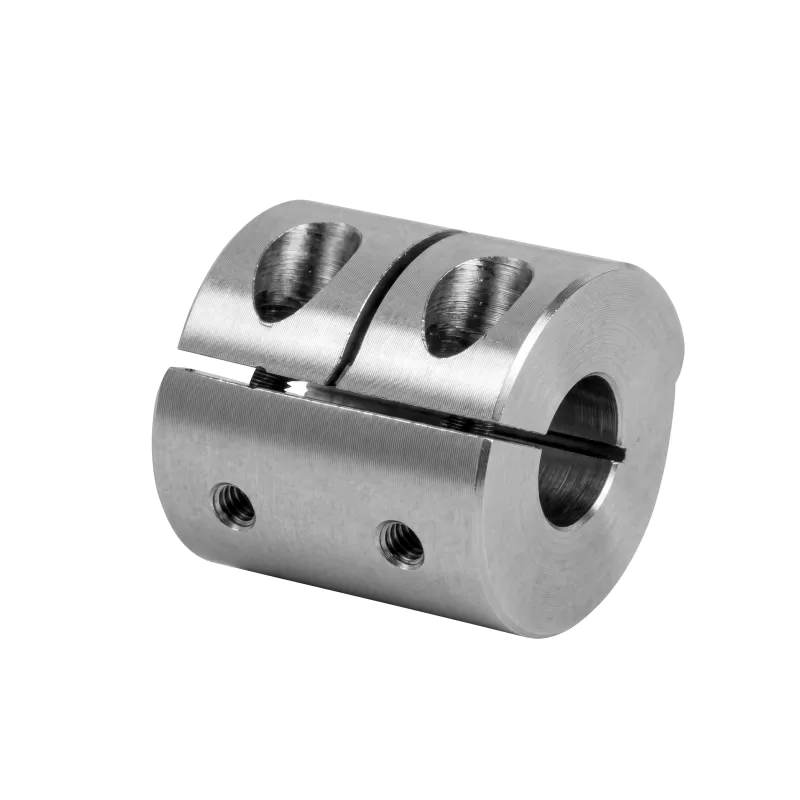
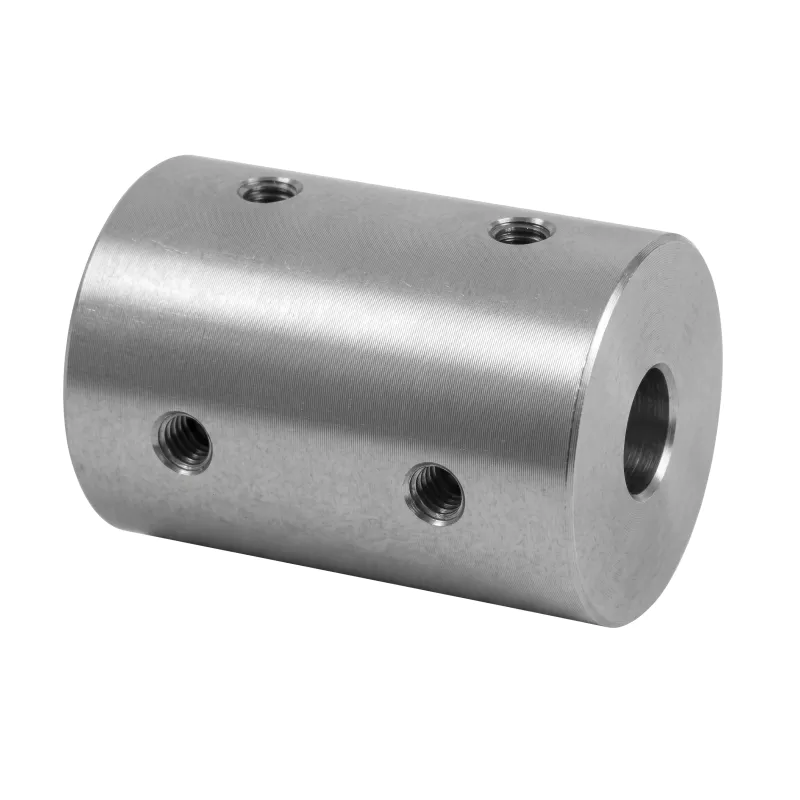
TS7-16 Setscrew Type Rigid Coupling – Aluminum Alloy Miniature Precision Shaft Connector
The TS7-16 setscrew type rigid coupling is a miniature, lightweight shaft connector designed for precision motion control applications where zero backlash, ultra-low rotational inertia, and consistent torque transmission are non-negotiable requirements. With a 16 mm outer diameter body machined from high-strength aluminum alloy, this coupling connects two shafts of equal or differing diameters in a perfectly rigid assembly, ensuring that angular position on the driving shaft is replicated with absolute fidelity on the driven side. It is the coupling of choice for servo motor to leadscrew connections, encoder mounting shafts, rotary stage drives, and any precision automation axis where position accuracy is paramount.
The setscrew fastening mechanism uses two M3 grub screws per hub — one per shaft side — tightened to a specified wrench torque to lock the coupling body onto each shaft end. This arrangement provides a secure, repeatable connection without requiring a split-clamp body, keeping the outer diameter compact and the moment of inertia at an absolute minimum. The rotational inertia of the TS7-16 is just 3.1 × 10⁻⁷ kg·m², making it one of the lowest-inertia rigid couplings available in the 16 mm OD class. For drive systems where servo amplifier inertia ratio calculations are critical, this figure directly reduces the reflected inertia seen at the motor shaft.
Shaft bores of 3, 4, 5, and 6 mm are available within the TS7-16 frame size, covering the full range of miniature servo motor output shafts and instrumentation shaft diameters common in this torque class. For applications requiring corrosion resistance — food processing equipment, laboratory instruments, coastal or marine environments — the equivalent stainless steel model STS7-16 provides identical geometry and torque ratings in 316 stainless steel construction. Both variants are described on our full product catalog page.
Technical Specifications
| Parameter | Value |
|---|---|
| Model | TS7-16 |
| Series | TS7 Setscrew Type Rigid Coupling |
| Body Material | Aluminum Alloy |
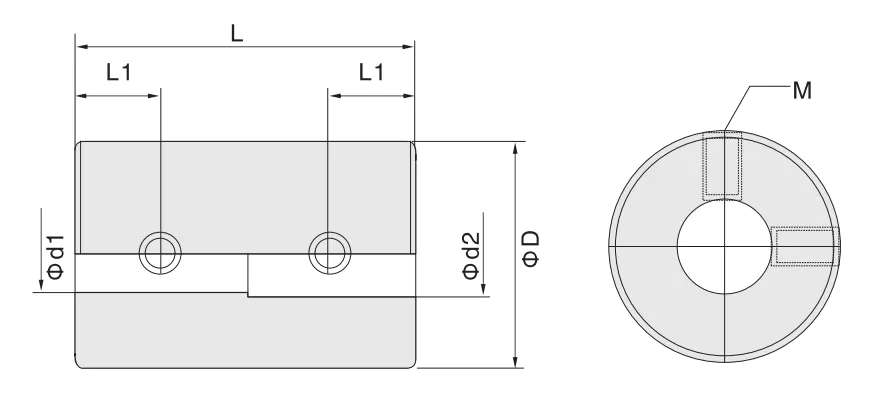
| Outer Diameter (D) | 16 mm |
| Overall Length (L) | 24 mm |
| Hub Length (L1) | 6 mm |
| Available Bore Sizes | 3, 4, 5, 6 mm |
| Setscrew Thread | M3 |
| Wrench Torque | 0.7 N·m |
| Rated Torque | 0.3 N·m |
| Maximum Torque | 0.6 N·m |
| Maximum Rotational Speed | 23,000 rpm |
| Moment of Inertia | 3.1 × 10⁻⁷ kg·m² |
| Mass | 11 g |
* Moment of inertia and mass figures are calculated at maximum shaft bore.
Dimensions
Materials and Construction
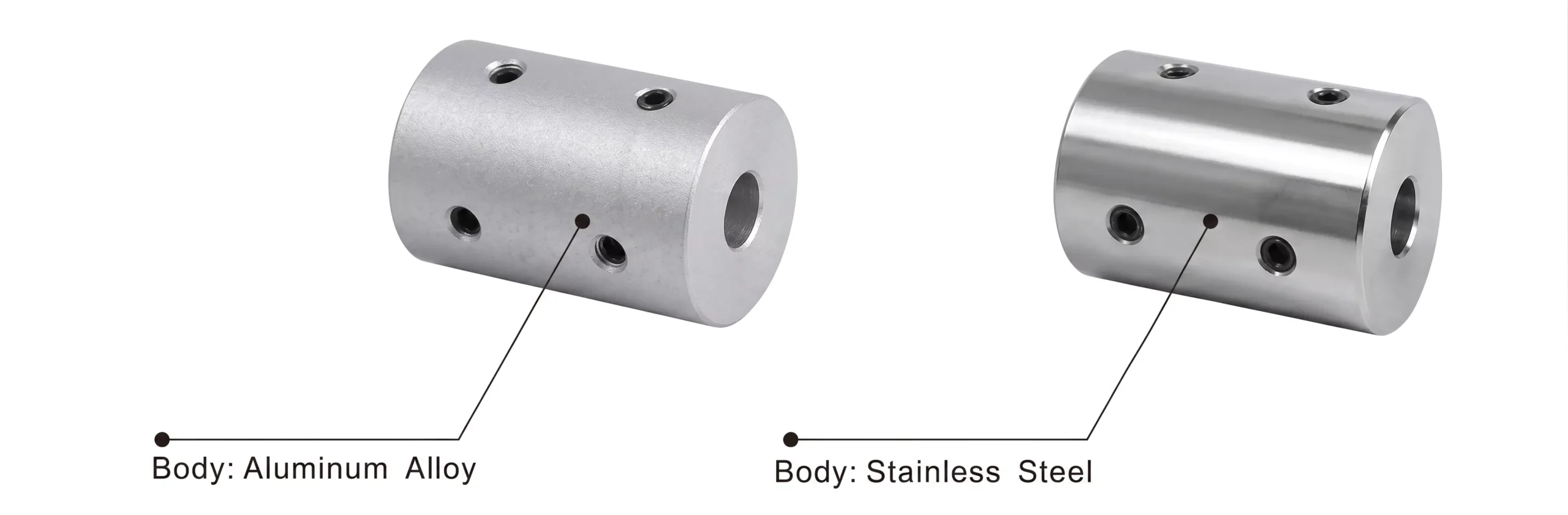
The TS7-16 body is precision-machined from aerospace-grade aluminum alloy, offering an excellent balance of mechanical strength and low mass. The alloy selection provides adequate surface hardness to retain setscrew clamping force across extended service cycles while keeping the total mass at 11 g — a figure that matters significantly in high-speed or high-cycle applications where coupling mass contributes to system inertia. The natural anodised or clear-coated finish provides moderate oxidation resistance for indoor industrial environments. For environments with active corrosive exposure, the STS7-16 stainless steel variant is the specified alternative.
The two-piece setscrew design (one grub screw per shaft side, positioned 90° offset where geometry permits) provides a directionally balanced clamping arrangement. Setscrews are supplied fitted; the recommended installation sequence is to insert both shafts to the correct depth — marked by the L1 hub length dimension — and tighten each setscrew to exactly 0.7 N·m using a calibrated hex key. Over-tightening beyond this figure risks shaft surface deformation without meaningfully increasing holding torque.
Key Features and Application Benefits
Zero Backlash
Rigid one-piece body construction with setscrew clamping delivers absolute zero backlash — every angular movement on the input shaft is transmitted directly to the output shaft with no lost motion.
Ultra-Low Inertia
At 3.1 × 10⁻⁷ kg·m², the TS7-16 adds negligible reflected inertia to servo and stepper motor drive systems, preserving servo loop bandwidth and dynamic response.
High Rotational Speed
Rated to 23,000 rpm maximum speed — the highest in the TS7 series — making the TS7-16 suitable for high-speed spindle connections, dental drill auxiliary drives, and precision turbine encoder shafts.
Lightweight Construction
Aluminum alloy body at 11 g minimises the gravitational and dynamic load contribution from the coupling itself, benefiting vertically mounted or weight-sensitive axis configurations.
Typical Applications
The TS7-16 miniature rigid coupling is specified across a broad range of precision motion and instrumentation applications:
- Servo motor to encoder shaft connections — where angular fidelity between motor rotor and encoder disc must be maintained to the sub-arc-minute level
- Leadscrew drives in CNC machines and 3D printers — coupling the stepper or servo motor output shaft to the ball screw end, ensuring positional accuracy without cumulative backlash
- Rotary table and indexing head drives — where the coupling must sustain repetitive stop-start cycles without fretting or loosening
- Laboratory and scientific instrument drives — spectrometers, optical alignment systems, scanning stages
- Medical device axis drives — fluid dispensing pumps, diagnostic positioning systems
- Robotics joint connections — lightweight arms and articulated platforms where coupling mass directly affects payload capacity
For a complete overview of where rigid shaft couplings are applied across industrial sectors, visit our product range page.
Ordering Information
To order, specify the model as: TS7-16 – [d1 bore] – [d2 bore]. For example, TS7-16-0406 indicates a TS7-16 coupling with d1 bore of 4 mm and d2 bore of 6 mm. Both bores must fall within the available sizes of 3, 4, 5, and 6 mm for this frame size. Equal bore (d1 = d2) configurations are standard; mixed bore configurations are available without additional charge.
Customer Reviews and Case Studies
★★★★★
Germany — Precision Automation OEM
We integrated TS7-16 couplings into our servo-driven linear axis modules for semiconductor handling equipment. The zero-backlash performance has been consistent across over 12 months of continuous production cycling. The rotational inertia figure is accurate — our servo tuning calculations aligned precisely with measured results. We will continue specifying this model for new axis builds.
— Engineering Manager, Stuttgart
★★★★★
Japan — Laboratory Instrument Manufacturer
We use the TS7-16 in optical scanning stage drives where angular position error must remain below 0.01 degrees. The coupling meets this requirement without any play or thermal drift over the operating temperature range of our instrument. Dimensional accuracy between batches has been excellent — no re-qualification required on second and third orders.
— R&D Procurement, Tokyo
★★★★☆
United Kingdom — Medical Device Assembly
Specified for a fluid dispensing pump axis in a diagnostic device. The lightweight construction reduced the overall axis moving mass, which improved our pump’s acceleration profile. Documentation including dimensional inspection data was provided with the batch — this was a requirement for our device design file. Satisfied with the product and the pre-sales technical support received.
— Procurement Engineer, Cambridge
Frequently Asked Questions
What bore size combinations are available for the TS7-16?
The TS7-16 accepts bore diameters of 3, 4, 5, and 6 mm on each side. Both d1 and d2 can be any combination within this range — equal bore (e.g. 4/4 mm) and mixed bore (e.g. 4/6 mm) configurations are both available at no additional cost. Specify your required bore pair when placing an enquiry.
Can the TS7-16 handle shaft misalignment?
No. As a rigid coupling, the TS7-16 transmits torque through a completely fixed connection — it does not compensate for angular, parallel, or axial misalignment between shaft ends. Both shafts must be accurately aligned before installation. Any residual misalignment will be transmitted as a bending load to shaft bearings, reducing bearing service life.
What is the correct setscrew tightening torque for this model?
The M3 setscrews on the TS7-16 should be tightened to exactly 0.7 N·m using a calibrated hex key or torque driver. This is the specified wrench torque for this frame size. Over-tightening beyond this figure risks deforming the shaft surface without improving holding force, and may make disassembly difficult.
What is the difference between the TS7-16 and STS7-16?
The TS7-16 is manufactured from aluminum alloy with a mass of 11 g. The STS7-16 is dimensionally identical — same OD, same bore range, same torque and speed ratings — but made from 316 stainless steel, increasing the mass to 28 g. Choose the STS7-16 for environments with active corrosive exposure: food processing, pharmaceutical, chemical, or coastal/marine applications.
Is material certification and documentation available?
Yes. Material certificates and dimensional inspection reports can be issued on request at the time of ordering. These documents support OEM design file submissions, regulated industry procurement processes, and project quality records. Please indicate your documentation requirement when submitting your enquiry.
Ready to Source the TS7-16 Rigid Coupling?
Ever Power supplies the TS7-16 and the full TS7 setscrew rigid coupling range direct from our manufacturing facility. Tell us your bore sizes, quantity, and application — our engineering team will confirm availability and pricing.